

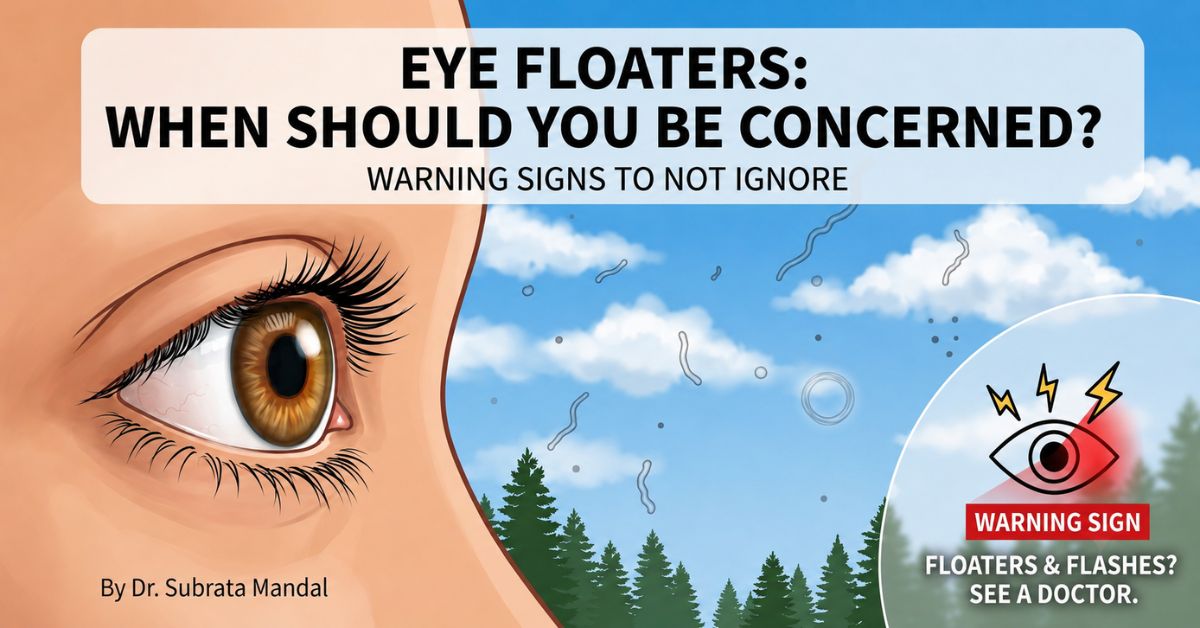
👁️ Seeing spots, dots, threads, or cobweb-like shapes in your vision?
These are commonly called floaters.
Floaters are small shapes that appear to move across your field of vision. They may look like tiny dots, strands, rings, clouds, or cobwebs. They are usually caused by tiny structures or changes within the vitreous, the clear, gel-like substance that fills the inside of the eye.

What causes floaters?
Eye floaters are caused by opacities or condensations in the vitreous that cast shadows on the retina. Important causes include:
Common causes:
- Posterior vitreous detachment (PVD) – the most common cause, especially with increasing age or high myopia.
- Vitreous syneresis – age-related liquefaction and aggregation of vitreous collagen.
- Myopia – earlier vitreous degeneration and PVD.
- Age-related vitreous changes.
Important pathological causes:
- Retinal tear/horseshoe tear (HST) – floaters may occur with flashes; potentially associated with retinal detachment.
- Rhegmatogenous retinal detachment – sudden increase in floaters, flashes and/or curtain-like field defect.
- Vitreous hemorrhage – commonly from:
- Posterior uveitis / vitritis – inflammatory cells in the vitreous.
- Endophthalmitis – severe intraocular inflammation/infection.
- Asteroid hyalosis – multiple refractile calcium-lipid bodies within the vitreous.
- Synchysis scintillans – cholesterol crystals in a degenerated vitreous.
- Intraocular inflammation – e.g., intermediate uveitis.
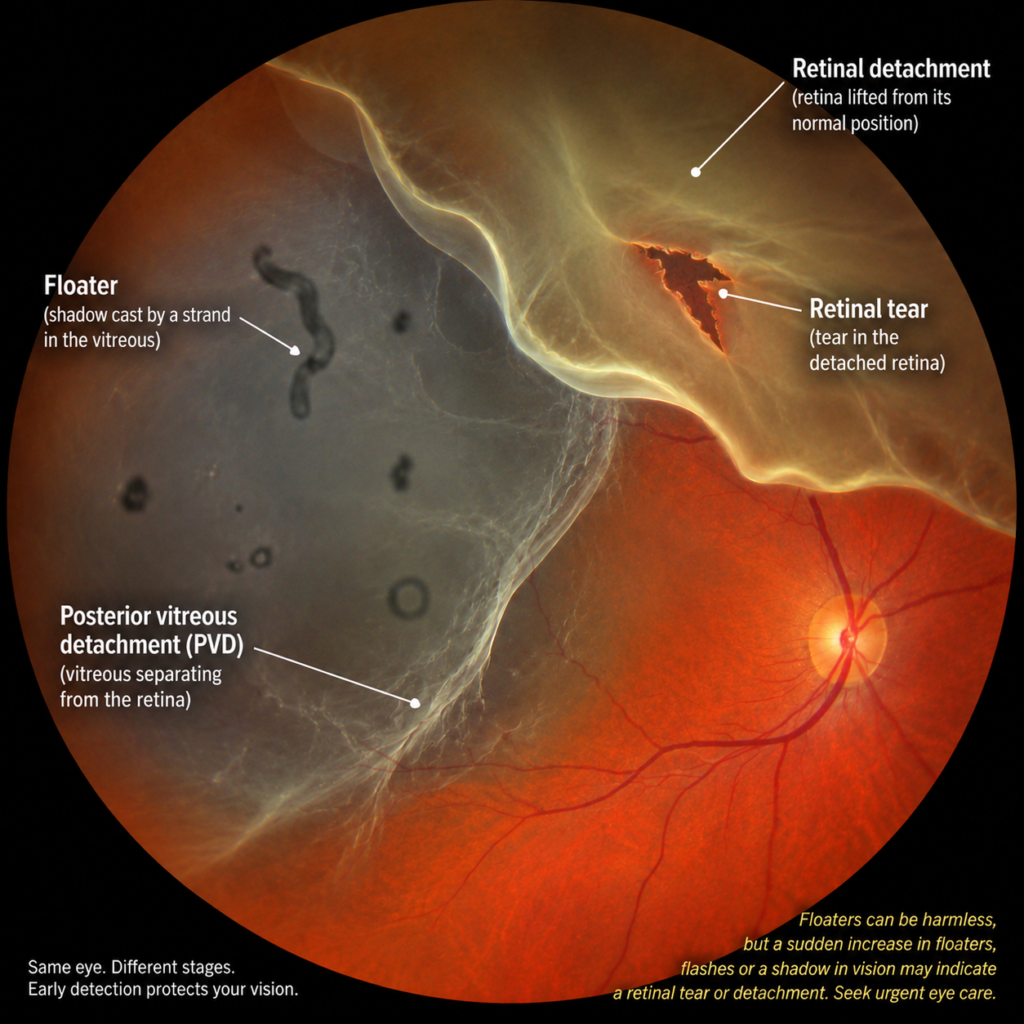
One of the most common causes, particularly with increasing age, is posterior vitreous detachment (PVD).
The vitreous gel is normally attached to the retina, the light-sensitive layer at the back of the eye. With age, the vitreous gradually becomes more liquid and can separate from the retina. This separation is called posterior vitreous detachment.
PVD is common and often does not cause permanent vision problems. However, as the vitreous separates, it can sometimes pull on the retina. In some people, this traction can produce a retinal tear.
A retinal tear can occasionally progress to a retinal detachment, which is a sight-threatening emergency.
🚨 Warning signs that should NOT be ignored
Seek urgent ophthalmic assessment if you experience:
🔴 A sudden appearance or sudden increase in floaters
⚡ Flashes of light, particularly at the side of your vision
🌑 A dark curtain, shadow, or veil appearing across your vision
👁️ Sudden reduction or distortion of vision
🔴 New symptoms occurring suddenly in one eye
These symptoms do not necessarily mean that a retinal tear or retinal detachment has occurred, but they need prompt examination to rule out these potentially serious conditions.
Why is PVD particularly important?
Many people with PVD have a benign course and require only observation. The important point is that PVD itself cannot always be distinguished from a retinal tear based on symptoms alone.
A dilated retinal examination allows an eye specialist to examine the peripheral retina and look for retinal tears or other abnormalities.
Sometimes, the initial examination may be normal but symptoms can continue or change. Your ophthalmologist may therefore recommend follow-up depending on your symptoms and examination findings.
Who may be at higher risk?
The risk of retinal complications associated with vitreous changes can be higher in people with factors such as:
- Increasing age
• Significant short-sightedness (high myopia)
• Previous cataract or other eye surgery
• Previous retinal tear or retinal detachment
• Eye trauma
• A family history of retinal detachment
Remember 👁️
Floaters are common, but a sudden change in floaters is not something to ignore.
If you suddenly notice many new showers of dot floaters, flashes, or a shadow/curtain in your vision, do not wait for the symptoms to disappear on their own. Arrange an urgent eye examination.
Early detection of a retinal tear can allow treatment before a retinal detachment develops.
Figure: Retinal detachment due to posterior vitreous detachment
A useful clinical rule
- New-onset dot floaters + flashes = exclude retinal tear urgently.
- If accompanied by a curtain/shadow or visual-field loss, retinal detachment must be considered an emergency.
Protect your vision. Know the warning signs. Get your eyes checked promptly when symptoms suddenly change.