

Are eye problems keeping you up at night? Are you searching for affordable eye solutions in Kolkata?
Well, look no further than Dr Subrata Mandal. As the best eye surgeon in Kolkata, he will ensure that you get the best outcomes at a reasonable rate!
The Eye: Your Medium to View The World
The Eye
The eye is a complicated organ that is responsible for vision. This function allows us to feel and perceive the world around us. It is spherical in shape and is located in the eye socket of the skull. Some of its critical parts include the retina, cornea, iris, pupil and the optic nerve. The eye focuses on the incoming light through the lens and the retina. The retina contains the rod and cone cells. Rod cells allow us to see in dim light, while cone cells help our vision in bright light. Together, these cells convert light into electric signals, which are then sent to the brain for processing into coherent images.
Overall, the eye is a complex organ that performs a number of complex functions, which allow us to see the world around us. Under Dr Subrata Mandal, the best eye surgeon in Kolkata, you can be assured that your eyes are under expert care.
The Most Common Eye Problems
Eye issues are a huge concern all over the world. Considering this, the most common eye issues are blurred vision, cloudiness in the visual field, refractive errors, and dry eye syndrome. However, you must note that these conditions are recognised as major conditions. Some minor conditions include chalazia, blepharitis, and eye strain. Most of these conditions are treatable at home with minimal interventions. However, for major conditions like glaucoma or cataracts, surgical intervention is a necessity. For this reason, most come to Dr Subrata Mandal, the best eye surgeon in Kolkata.
Dr Mandal suggests appropriate care based on the condition’s state. For instance, home remedies are suggested for conditions like chalazia and styes. The most common cure suggested by the doctor for these conditions is hot compresses. On the other hand, if the condition is found to be severe, surgical interventions are recommended. In such a state, if you are under the care of the best eye surgeon in Kolkata, you can be assured that everything will be alright.
Why are Eye Problems an issue in India
Eye problems are a huge concern for Indian people. Recent research has shown that some notable reasons are causing this. Some of these reasons are a lack of access to eye care, economic constraints, infrastructural limitations, and limited awareness about the conditions. In fact, in recent years, the situation has become so fatal that India is often referred to as the “blind capital of the world.”
Recent research has come up with shocking results. As per the findings of The Lancet, the major chunk of people suffering from ophthalmological conditions are people over the age of 40, pregnant women, and diabetics. Diabetic Retinopathy remains the number one cause of vision impairment in the country, followed by glaucoma and cataracts. The same study has also found that men are much more vulnerable to ocular issues than women, yet are surprisingly unwilling to visit a doctor compared to women. This is not a very good sign. It is always wise to visit a nearby ophthalmologist when you see the first symptoms. Pay a visit to Dr Subrata Mandal, the best eye surgeon in Kolkata today, for the best outcomes.
Dr Subrata Mandal: The Best Eye Surgeon in Kolkata
Know Your Doctor
Dr Subrata Mandal is one of the leading ophthalmologists in West Bengal. Considered to be the best eye surgeon in Kolkata, he has earned a reputation for certain qualities like accurate diagnosis, compassionate care, and precise surgical abilities. Trained at the reputed institution, Dr RP Centre, AIIMS, New Delhi, his specialities include Vitreo-Retinal and Uvea Disorders, Cataract Surgery and Diabetic Eye Disease Management. His treatment approach is notable for combining evidence-based and patient-centric approaches in order to deliver long-term positive outcomes.
He ensures the dignity and health of his patients by giving them the best possible care. That is why he is regarded to be the best eye surgeon in Kolkata.
Qualifications
Academic
The Academic Qualifications of Dr Subrata Mandal, the best eye surgeon in Kolkata, are:
- MBBS (Hons. In Eye & ENT), NRS Medical College, Calcutta (Institution), CU, September 2001
- MD Ophthalmology (Gold Medalist) from Dr Rajendra Prasad Centre For Ophthalmic Sciences, AIIMS (New Delhi), July 2005
- DNB (Ophthalmology), National Board of Examination, 2006
- FRCS (Ophthalmology), Glasgow, 2008
- Senior Resident (Vitreo-Retina & Uvea) from Dr Rajendra Prasad Centre For Ophthalmic Sciences, AIIMS (New Delhi), 23.07.2005 To 22.07.2008
Professional Memberships
Some professional memberships of Dr Subrata Mandal, the best eye surgeon in Kolkata, are:
- Delhi Ophthalmological Society – Life Member
- All India Ophthalmological Society – Life Member
- Member of the AIIMSONIANS association – Life Member
- Member of the Indian Medical Association – Life Member
Skills
Some of the most notable skills of Dr Subrata Mandal, the best eye surgeon in Kolkata, include:
- Precise surgical skills
- Excellent communication skills to reach the heart of the problem
- Updated with the latest ophthalmological technologies
- Maintains the highest standard of care
Why Dr Mandal?
Renowned Ophthalmologist
Dr. Subrata Mandal has received considerable recognition for his clinical expertise, surgical skills, and high-quality eye care services. With vast exposure to numerous eye diseases and surgeries, patients trust him for the right diagnosis, and they have had good outcomes with him. Dr. Mandal is the best eye surgeon in Kolkata for a reason, and that is simple- from experience, skill, knowledge and patients’ satisfaction have made him one of the best.
Access to Latest Technologies
Dr. Mandal uses the latest diagnostic and surgical technology for an accurate diagnosis and is able to provide patients with a less invasive alternative treatment. Patients now can benefit from laser-assisted cataract surgery in addition to other world-class medical technology, like retinal imaging capture with a high-resolution camera.
Customisable Treatment Plans
Every patient is accepted into a personalized treatment protocol that considers the patient’s condition, lifestyle, and overall visual goals. Dr. Mandal spends time explaining the alternative options after providing his recommendation for the best possible path for care.
Patient Awareness and Support
Providing open communication, with education for the patient, is front and centre for his personalised care approach with every patient. He takes the time to guide the patient through every stage of the preparation, treatment, and follow-up phases.
Warm and Friendly Environment
The clinic intends to provide the patients with a welcoming, safe environment that values your health and well-being above all, reducing your stress and anxiety during the treatment process.
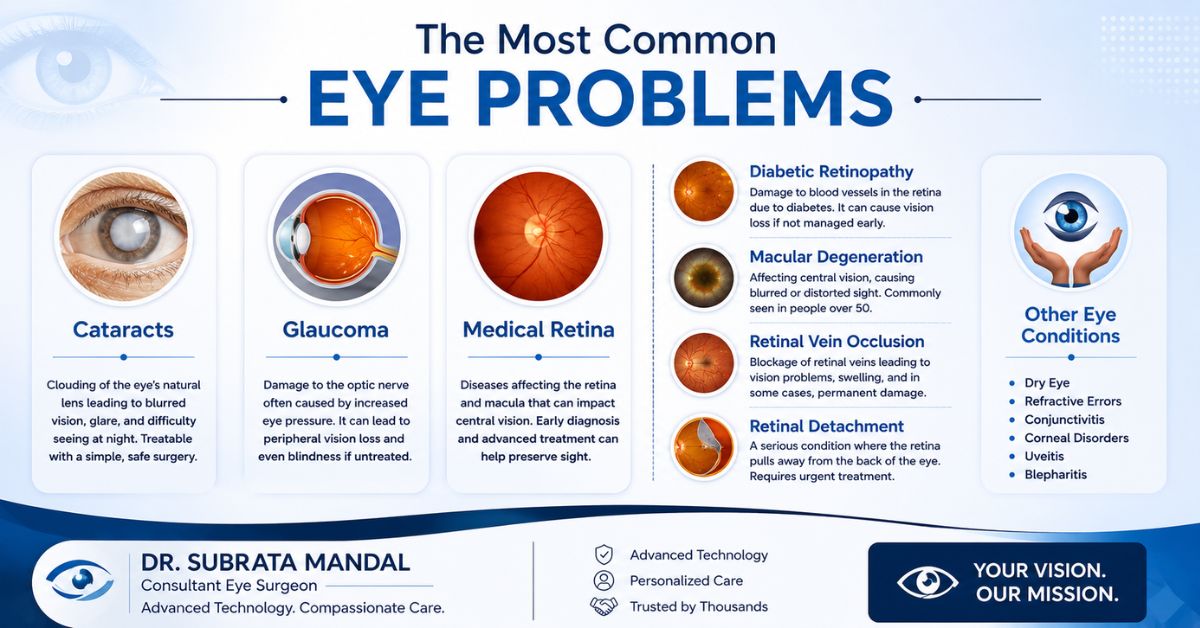
The Most Common Eye Problems
Cataracts
Cataracts are cloudy areas that affect the lens of the eye. The natural lens of your eye is clear in its normal state. It is made up of proteins known as crystallins. As one grows older, these proteins go through a process of breakdown, which weakens your eyesight. Many suffering from cataracts report that they feel as if they are viewing the world from a dirty window. In such a condition, if you do not see an ophthalmologist, you are paving the way for vision impairment. As time goes on, you will feel as if you are unable to do even the basic tasks.
Along with this, you must also keep in mind one thing: cataracts are a natural part of ageing. There is no need to worry. The only thing you need to do is contact the best eye surgeon in Kolkata, Dr Subrata Mandal.
There are three types of cataracts that are known. These are: Pediatric cataracts, Traumatic cataracts, and Secondary cataracts.
How common are cataracts?
Cataracts are a leading eye health issue in India. As per recent estimates, nearly ten lakh people fall victim to this condition annually. Research has also suggested that the increase in cases is directly proportional to an ageing population. That is why professionals like Dr Subrata Mandal, the best eye surgeon in Kolkata, are trying to provide the best care to the people.
Glaucoma
Glaucoma is a type of condition that causes damage to the optic nerve. This is one of the key nerves ensuring vision, as it transmits information from the eye to the brain. This condition is mostly caused by minor conditions like eye strain. Eye strain often leads to an increase in intraocular pressure (IOP). This pressure leads to damage to optic nerve fibres. This is an alarming stage, as it almost always leads to permanent blindness. Considering these, symptoms such as night vision struggles, gradual loss of peripheral vision, eye strain, and headaches. However, you must keep in mind that these symptoms will most likely appear when the glaucoma has reached an advanced stage. Otherwise, glaucoma is infamous for having no symptoms at all. Therefore, the moment you face any troubles with your vision, be sure to contact Dr Subrata Mandal, the best eye surgeon in Kolkata. His guidance and treatment will help you a lot in the long term.
How common is glaucoma?
Glaucoma in India is a significant concern. Annually, it is estimated that more than 11.9 million Indians fall victim to this condition. It is a leading cause of irreparable blindness in India. Research has shown that due to a lack of awareness regarding the condition. In fact, most get diagnosed at advanced stages. Therefore, regular checkups are mandatory for the maintenance of long-term eye health.
Medical Retina
Diabetic Retinopathy
Diabetic Retinopathy is an eye condition that is caused by high levels of sugar in the blood. This sugar causes significant damage to the fragile blood vessels. During its initial stage, it causes weakening of the blood vessels, which causes leakage. Over time, as it goes through different stages, tiny leakages and rupturing of blood vessels occur. Ultimately, it leads to irreparable loss of vision. Throughout the stages, abnormal growth of blood vessels occurs, accompanied by moderate to severe bleeding. This is called proliferative retinopathy. The best way to deal with diabetic retinopathy is early detection and effective condition management. For the best treatment, visit Dr Subrata Mandal, the best eye surgeon in Kolkata.
Macular Degeneration
Macular Degeneration is a progressive ocular condition that affects an individual’s central vision. Central vision is responsible for ensuring that we can see the world in a clear and detailed way. Therefore, the loss of this type of vision leads to several problems, such as difficulty reading, driving, and recognising faces. Considering this, there are two main types of AMD. These are: atrophic degeneration and neovascular degeneration. The more common type of AMD is atrophic degeneration. In case one is affected by this condition, you will experience deposits called drusen along with dry eyes. In contrast, neovascular AMD is wet and is characterised by leaking blood vessels. For more information regarding both, visit Dr Subrata Mandal, the best eye surgeon in Kolkata.
Retinal Vein Occlusion
Retinal Vein Occlusion is an eye condition where the smaller veins that carry blood away from the retina are blocked. This leads to blurred vision and later loss of vision. The two main causes of this condition are atherosclerosis and blood clots. Considering this, the two main types of this condition are Central Retinal Vein Occlusion and Branch Retinal Vein Occlusion. The only way to avoid this is to ensure early treatment. In light of this, treatment might include injections that can help reduce swelling and abnormal growth of blood vessels. Further, the management of high blood pressure levels can also prove to be great help. For more treatment-related concerns, consult Dr Subrata Mandal, the best eye surgeon in Kolkata.
Retinal Detachment
Retinal Detachment is a medical emergency in which the retina of the eye detaches from the supporting tissues. This detachment deprives the retina of oxygen and essential nutrients, which leads to declining vision. Under such conditions, if urgent surgical intervention is not provided, it can lead to permanent blindness. The initial stages of this condition can be detected through floaters, light flashes, and blurred vision. The affected feels as if there is a curtain over their vision field. Considering this, there are three types of retinal detachment. These are Rhegmatogenous, Tractional, and Exudative. The type of treatment depends on the nature of the condition. For the best treatment, consult Dr Subrata Mandal, the best eye surgeon in Kolkata.
Uveitis
Uveitis is a condition where the uvea of the eye gets inflamed. The uvea lies in the middle layer of the eye’s wall, which includes the ciliary body, iris, and choroid. If ignored, the inflammation leads to symptoms such as pain, blurred vision, sensitivity to light, and the appearance of floaters in the visual field
Common Symptoms, Causes and Risks of Eye Problems
Common Symptoms
Vision problems can affect individuals at any age, so detecting these problems as soon as possible is critical to receiving treatment in a timely manner. Blurred or distorted vision is one of the most common issues, and it is often related to refractive vision errors, cataracts, or issues with the retina. If you have had sustained redness, irritation, or itching, this may indicate allergies, an infection, or dry eyes. Watery eyes or excessive tearing often occur when the tear ducts are blocked or inflamed. Sensitivity to light (photophobia) can indicate a problem with the cornea or uveitis. Many people also suffer from periodic headaches due to eye strain, especially if they are looking at a screen for a prolonged period of time.
Another common symptom is floaters, flashes of light, or dark spots in the field of vision. These may be harmless, but they can also point to retinal detachment that requires care right away. Double vision, a sudden onset of vision loss, or trouble seeing at night are examples of problems that should never be ignored. Pain around or in the eyes should also be taken seriously. This is often a sign of a serious infection or possible glaucoma.
If any of these are occurring, you need to see a qualified specialist. Dr. Subrata Mandal is the best eye surgeon in Kolkata who has provided diagnostics and advanced treatment to care for your vision.
Causes
Common symptoms associated with eye issues can arise from a multitude of causes. Blurry or unclear vision is typically due to a refractive error, often related to myopia, hyperopia, or astigmatism. However, blurry vision may also occur from cataracts or any of a number of progressive retinal diseases or disorders. Redness, irritation, and itchiness of the eyes are often related to allergic reactions, infections, such as bacterial or viral conjunctivitis, or simply chronic dry eye disease. Similarly, watery or excessive tearing may occur when production of tears is abnormal, or when the drainage system for tears is compromised in some way.
Light sensitivity may occur with a corneal abrasion, or inflammation of the interior of the eye (uveitis), or migraine headaches, etc. Headaches and eye-strain are often related to prolonged screen-use, glasses prescriptions being inaccurate for the correction/intended purposes, or of course, uncorrected vision problems. Floaters or flashes of light can occur as a result of the natural aging process of the vitreous gel. However, floaters of light may sometimes indicate retinal tearing or detachment requiring immediate care.
Pain in the eye or surrounding the eye may signify glaucoma, infections, and/or serious inflammation. Double vision or sudden loss of vision often signifies neurological or retinal causes requiring immediate evaluation. Seeing Dr. Subrata Mandal, the best eye surgeon in Kolkata, or an eye care professional for any of the above symptoms will be imperative in obtaining potentially the best or optimal diagnosis and treatment.
Risks
Neglecting early signs of issues affects your overall ocular health and potential long-term vision risks. For instance, if you have refractive errors that go untreated, these errors may eventually worsen, leading to visual discomfort and difficulty completing activities of daily living. Prolonged eye dryness or ongoing irritation may compromise the corneal surface. This means your risk of infections increases over time. Infections such as conjunctivitis, if left untreated, may cause an upward, deeper spread affecting the more serious intraocular infection that carries a higher risk and complications.
Light sensitivity or headaches related to eye strain can lead to poor concentration, disrupt productivity, and impact your quality of life. Furthermore, if serious conditions such as glaucoma go unrecognised and untreated, your optic nerve may undergo irreversible damage, leading to more serious sight loss. Flashes or sudden floaters that you ignore may result in a misdiagnosed retinal detachment needing urgent care to protect your sight from potential blindness. Advanced cataracts may significantly decrease your overall vision, leading to a loss of independence or difficulty managing your daily activities.
Delaying your diagnosis or treatment puts you at an increased risk of both complications and reduced opportunities or outcomes for recovery. Simply stated, early intervention is key in protecting vision. Having your eyes evaluated by a qualified specialist such as Dr. Subrata Mandal, one of the best eye surgeon in Kolkata, allows for the potential risks to be identified and managed early on and at a higher standard.
Services Offered by Dr Subrata Mandal
Cataracts
Cataracts are among the most frequently encountered causes of vision impairment, especially in individuals over the age of 60. They occur when the eye’s natural lens becomes cloudy, which can result in blurry vision, sensitivity to bright lights, difficulty seeing in low light, and loss of definition. If untreated, cataracts can continue to worsen and ultimately hinder one’s ability to perform everyday tasks, including reading, driving, and recognising faces.
Dr. Subrata Mandal offers comprehensive and advanced cataract management, tailored to meet the specific needs of each patient. Treatment typically includes surgery to remove the clouded lens and replace it with a high-quality artificial lens, leading to clear vision again. Dr. Mandal specialises in Phacoemulsification, a minimally invasive technique using ultrasound technology to break up and remove the cataract through a small incision. Dr. Mandal has a variety of Intraocular Lens (IOL) implants, including monofocal, multifocal, and toric lenses, that help improve visual outcomes depending on lifestyle needs.
For additional safety, speed, and precision, Laser-Assisted Cataract Surgery will provide even more accurate incisions and have a rapid recovery. Comprehensive examinations and diagnostic tests of the eye will determine a thorough treatment plan.
With great training and above-standard patient care, Dr. Mandal is known as one of the best eye surgeons in Kolkata for cataract care.
Vitreo-Retina Surgery
The vitreous and retina are important parts of the visual system and can also be delicate. An injury or disease of the vitreous or retina can be serious and, without treatment, can lead to loss of vision. Common vitreoretinal problems include diabetic retinopathy, macular holes, retinal detachments, macular degeneration, and vitreous hemorrhage. The diseases of the vitreous and retina can often present with floaters, distorted vision, blurred vision, flashes of light or sudden dark patches in the field of vision.
Dr. Subrata Mandal provides advanced surgical care of these diseases with the use of refined microsurgical techniques and high-definition technology for diagnosis. Treatments for these diseases include Vitrectomy, where the vitreous gel is painstakingly removed to allow repair of the retina or sealing of retinal tears or removing internal membranes. Depending on the case, laser photocoagulation or cryotherapy may also restore stability in the retina when retinal detachments or tears are an issue.
Dr. Mandal treats diabetic eye disease with individualised management which includes injections, laser procedures, and surgical procedures, to restore or protect vision. Each treatment is also specifically designed with consideration for patient comfort, safety, and long-term visual outcomes.
Dr. Subrata Mandal has vast experience in the realm of all of his specialties and is a highly skilled professional, making him the best eye surgeon in Kolkata.
Medical Retina
The retina plays a critical role in capturing visual images and relaying signals to the brain. Therefore, when this delicate layer of tissue is damaged, it can have serious ramifications for vision. Medical Retina is focused on diagnosing retinal diseases and, when appropriate, providing non-surgical care for these diseases. Examples of retinal diseases include diabetic retinopathy, age-related macular degeneration (AMD), retinal vein occlusions, central serous retinopathy (CSR), and macular edema. Most of these diseases can develop slowly and often present with symptoms of blurred or distorted vision, difficulty reading, impaired night vision, or the development of floaters.
Dr. Subrata Mandal provides a full spectrum of medical management for retinal conditions and uses state-of-the-art diagnostics, which include Optical Coherence Tomography (OCT), Fundus Fluorescein Angiography (FFA), and detailed retina imaging. Treatment options may involve any combination of intravitreal injections, retinal lasers, and targeted medications to reduce inflammation, bleeding, and/or further damage to the retina. These therapies can stabilise vision and, in many instances, resolve potential reversible vision loss while improving the patient’s quality of vision and life.
In a patient-centric manner, Dr. Mandal provides close follow-up care that is tailored to the severity and progression of the eye disease. His experience in early detection and timely intervention will assist in preventing complications and ensuring long-term vision preservation.
Dr. Subrata Mandal is highly regarded for his ability to provide precise care with great clinical skill and is the best eye surgeon in Kolkata.
Diabetic Retinopathy
Diabetic retinopathy is a serious condition that damages tiny blood vessels in the retina due to high blood sugar levels. It is one of the leading causes of visual impairment and blindness in patients with diabetes. It can develop gradually and often there may be no symptoms early on, so regular eye exams very important for early detection. Symptoms can include blurred vision, dark spots, floaters, fluctuating vision, or difficulty seeing at night.
Dr. Subrata Mandal provides full-service care for diabetic retinopathy, with the goal of making an early diagnosis and then effectively managing the patient to avoid vision loss. The office uses state-of-the-art diagnostic tools for proper diagnosis of the stage and severity of the disease, which include fundus fluorescein angiography, optical coherence tomography (OCT), and retinal imaging.
Treatment is patient-centred and may include retinal laser therapy, intravitreal anti-VEGF injections, and corticosteroid injections, as well as potentially surgical options like vitrectomy for advanced disease to remove the blood-filled vitreous or repair retinal damage. Care for diabetic retinopathy is ongoing with monitoring and management in concert with the patient’s other diabetes care providers to help maximise long-term vision potential.
Dr. Subrata Mandal is recognised amongst trustworthy ophthalmologists in Kolkata and is the best eye surgeon in Kolkata with extensive experience managing complex retinal diseases such as diabetic retinopathy. He offers the highest quality of diabetic retinopathy diagnosis, treatment, and follow-up care.
Uvea
The uvea is the eye’s middle layer, consisting of the iris, ciliary body, and choroid in the back, and is vital for providing nutrients to the eye and normal vision. When the uvea gets inflamed, known as uveitis, it can cause redness, pain, blurred vision, tearing, and light sensitivity. Uveitis can be caused by infection, autoimmune diseases, trauma, or a systemic disease like rheumatoid arthritis or tuberculosis. Uveitis can lead to complications like glaucoma, cataracts, or retinal damage if not treated promptly.
Dr. Subrata Mandal provides specialised evaluation and treatment for all types of uveitis, including anterior, intermediate, posterior, and panuveitis. A diagnosis consists of a comprehensive eye examination, laboratory testing, and imaging studies to determine the cause of uveitis. A patient’s treatment will be individualised, and may include anti-inflammatory medication, corticosteroid eye drops or injections, immunosuppressive therapy, and close follow-up to monitor progression.
Dr. Mandal takes a comprehensive, coordinated, and patient-centred approach to care to ensure both the ocular and systemic aspects of uveitis are managed well.
Due to his background in inflammatory eye disease, he is regarded as the best eye surgeon in Kolkata for uvea and uveitis care.
Contact Us
Book an appointment with Dr. Subrata Mandal, the best eye surgeon in Kolkata today!
Phone/ Emergency: +91 9874664924
Address: Street Number 18, CN Block, Sector V, Bidhannagar, Kolkata, WB 700091
Email: drsubratamandal@gmail.com
Do not neglect your eye problems! Contact today!
FAQs
- Who is recognised as the best eye surgeon in Kolkata?
Dr Subrata Mandal is recognised as the best eye surgeon in Kolkata because of his skills, clinical excellence, and patient-focused care.
- What eye conditions does Dr Subrata Mandal treat?
He treats cataracts, retinal conditions, diabetic retinopathy, macular conditions, glaucoma, uveitis, and other advanced and common eye conditions.
- How can I tell if I have cataracts?
Symptoms of cataracts include glare, or difficulty seeing at night, blurry vision and calefactions. You will know you have cataracts after an eye exam.
- What does Phacoemulsification mean in cataract surgery?
Phacoemulsification is a type of modern-day, minimally invasive cataract procedure that utilises ultrasound waves to gently remove the cloudy lens through a very small incision.
- Are there premium IOLs (internal optical lenses) available?
Yes, there are monofocal, multifocal, extended depth of focus and toric IOLs, depending on your visual needs.
- Is there an average time for cataract surgery?
It takes 10 – 20 minutes, on average, and most patients can go home the same day of the surgery.
- What is Laser-Assisted Cataract Surgery?
It uses laser technology to create precise incisions during cataract surgery, and can also help to improve safety in procedures.
- What is vitreoretinal surgery?
Includes surgical treatment of conditions involving the retina and vitreous, such as retinal detachments, macular holes, and vitreous hemorrhage.
- Is diabetic retinopathy curable?
Although diabetic retinopathy is not curable, it can be treated and improved vision can occur. Early detection and treatment are paramount.
- What is OCT?
Optical Coherence Tomography (OCT) is a painless and non-invasive scan that can provide detailed images of the retina for precise diagnosis.
- Does uveitis always require long-term treatment?
The length of treatment depends on the cause and severity. Some patients may resolve quickly, and other patients may require continuous treatment.
- Is retinal detachment an emergency?
Yes. Any sudden or new flashes, floaters, or a dark shadow or curtain in your field of vision require immediate medical attention.
- How often should I have my eyes examined?
Adults should have an eye examination once every 1-2 years; more often if you are diabetic or over age 60.
- Do you provide eye care for children?
Yes, children who have vision problems, crossing/ squinting, allergy issues, or refractive errors are examined and treated as necessary.
- Is cataract surgery painful?
The surgery itself is generally pain-free because anesthetic eye drops are used before and during the procedure.
- How soon can I go back to my regular daily activities after cataract surgery?
Most normal activities can be resumed in a few days; however, heavy lifting should be avoided for a short period.
- Does Dr Mandal provide personalised treatment plans?
Yes, each treatment plan is designed specifically for the patient based on eye condition, lifestyle, and visual goals.
- Are follow-up appointments necessary after treatment?
Yes, follow-up appointments are designed to monitor your healing and also provide the best visual outcome possible.
- How would I know if I need to see an eye doctor urgently?
If you have sudden vision loss, severe eye pain, flashing lights, or a “shadow” over your vision, you should see somebody right away.
- After I have cataract surgery, will it come back?
The cataract itself will not come back, but a thin membrane behind the lens may become cloudy over time. This can be fixed with a quick laser procedure (YAG capsulotomy) that is painless.
- Is cataract surgery safe in elderly people?
Yes. Cataract surgery is one of the safest and most commonly performed eye surgeries, even in older adults, in the hands of a trained and experienced eye specialist, like the best eye surgeon in Kolkata.
- What is diabetic macular edema?
Swelling in the centre of the retina due to leaking blood vessels from diabetes. Besides treatment, a patient can also receive injections, lasers or both.
- Do I have to wear glasses after cataract surgery?
Many patients will be less dependent on glasses, depending on the type of IOL implanted and the visual needs of the patient.
- Can uveitis affect both eyes?
Yes, uveitis can be only one eye or both eyes, depending on the underlying cause.
- Are problems with the retina hereditary?
Yes, some retinal conditions, like retinitis pigmentosa or certain macular conditions, can be genetic. The history of the family is an important
- How do I make an appointment?
Appointments can be scheduled by calls, emails, and texts.
- Why select Dr Subrata Mandal as your eye doctor?
He is the best eye surgeon in Kolkata due to his experience, cutting-edge technology, focus on educating patients, and dedication to the patient experience.